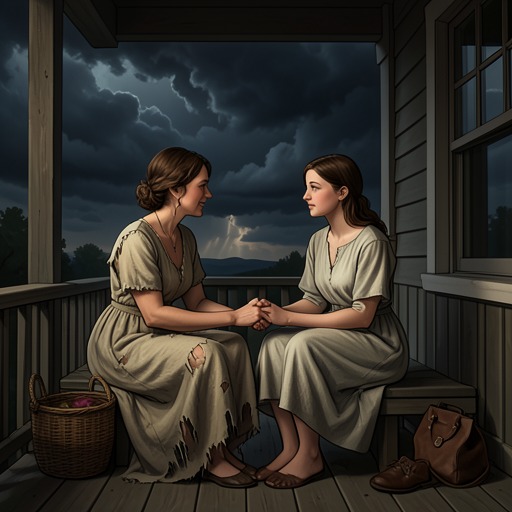
Mollie and Anna Brown’s sister relationship
Killers of the Flower MoonMollie Burkhart and Anna Brown were sisters whose relationship became central to the investigation of murders targeting Mollie’s family. Anna’s death was not an isolated killing: because of how the family’s wills and headrights were arranged, it altered the path of wealth through the family toward Mollie. The same plot that made their kinship a route for transferring property also made it the source of an enduring betrayal: Ernest Burkhart, Mollie’s husband, comforted her while concealing what he knew about Anna’s murder.
Sisters and the Inheritance at Stake
Anna Brown was divorced and had no children. She left nearly all her wealth to her mother, Lizzie, making Lizzie the next person whose death could redirect the family’s assets. Lizzie had willed most of her headright to her surviving daughters, Mollie and Rita Smith. Investigators came to see that the order of the deaths followed this inheritance structure: Anna was killed first, and Lizzie became the next target. The sisters’ connection therefore mattered not only as family history but as the means by which an inheritance could pass from one generation to another.
A headright could not legally be bought or sold, but it could be inherited. As White examined probate records, he saw that successive deaths were directing more headrights into Mollie’s hands. She was married to Ernest, William K. Hale’s nephew, whom an agent described as controlled by Hale. The evidence suggested a route from the family’s losses to Mollie’s inheritance, then through Ernest, whose wealth Hale could influence. White later described Mollie as the first means by which Hale could draw the family’s assets through the Burkharts. The investigation did not establish whether Ernest’s marriage to Mollie had been arranged as part of the scheme from the beginning or whether Hale persuaded him to betray her after they married.
Anna’s Murder and the Hidden Accomplices
The investigation connected Anna’s death to people who had appeared to be helping identify her killer. Ernest eventually named Kelsie Morrison, a bootlegger and bureau informant, as the man who had shot Anna. Morrison had acted as a double agent, passing information back to Hale and his associates while purporting to assist the authorities. His role made the search for Anna’s killer itself part of the deception.
At trial, Morrison testified that Hale wanted to eliminate the members of Mollie’s family so that Ernest would inherit their property. He said Hale recruited him to kill Anna and supplied a .380 automatic, while Bryan Burkhart acted as his accomplice. After Anna had been made too drunk to walk, Morrison and Bryan carried her down into a ravine at Three Mile Creek valley. Morrison’s account placed the murder inside the family’s circle: Bryan was Anna’s brother-in-law, and his participation implicated someone whose presence could appear natural at family moments that followed.
Grief, Testimony, and Recognition
A week after Anna was shot, Mollie went with her family to identify the body. Bryan was there, standing near Anna while feigning grief, though he had helped kill her. At the later trial, Mollie heard the account of how Bryan had gotten her sister drunk and helped prop her up while Morrison shot her in the back of the head. The testimony gave her a new understanding of a scene she had already lived through: Bryan had been beside her at the site, close to the body and to the family, while hiding his part in Anna’s death.
Morrison had also been among the onlookers. Ernest was there too, comforting Mollie, despite knowing that Anna’s killers were only a few feet away. He had known the truth from the time of the Smith house bombing as well, and had kept it from Mollie while she searched for the people responsible. His outward role as a consoling husband thus stood in direct contrast to his concealed knowledge of the violence surrounding her family.
The Relationship’s Rupture and Significance
By the time Morrison was convicted of Anna’s murder, Mollie could no longer look at Ernest. She soon divorced him, and the mention of his name made her recoil in horror. The discovery did not simply resolve the question of who had harmed her sister; it changed the meaning of Mollie’s own marriage. Ernest had shared a home and children with her while, as the investigation showed, her family’s deaths advanced a scheme from which he and Hale stood to benefit.
The sisters’ relationship gives the inheritance pattern its human consequence. Anna’s death began a sequence in which wealth could be concentrated in Mollie, while the people positioned closest to Mollie were implicated in the violence and its concealment. The plot depended on kinship as both a channel for inheritance and a cover for betrayal. For Mollie, the eventual revelation joined the loss of Anna to the collapse of trust in Ernest: the person who had comforted her had known the truth while she grieved and searched.